
Threads
of Power
Craft, Sacred Power & Global Connection in the Oseberg Ship Burial
How a master weaver's extraordinary toolkit, imported silks, and ritual objects reveal a woman whose craft was inseparable from fate, magic, and political authority.
The Collection
What Are the
Oseberg Textiles?
The Oseberg textiles are a collection of richly decorated fragments found in a high-status ship burial at Oseberg farm, Vestfold, Norway, dated to c. 834 CE — one of the most significant Viking Age archaeological discoveries ever made (Christensen and Nockert, 2006).
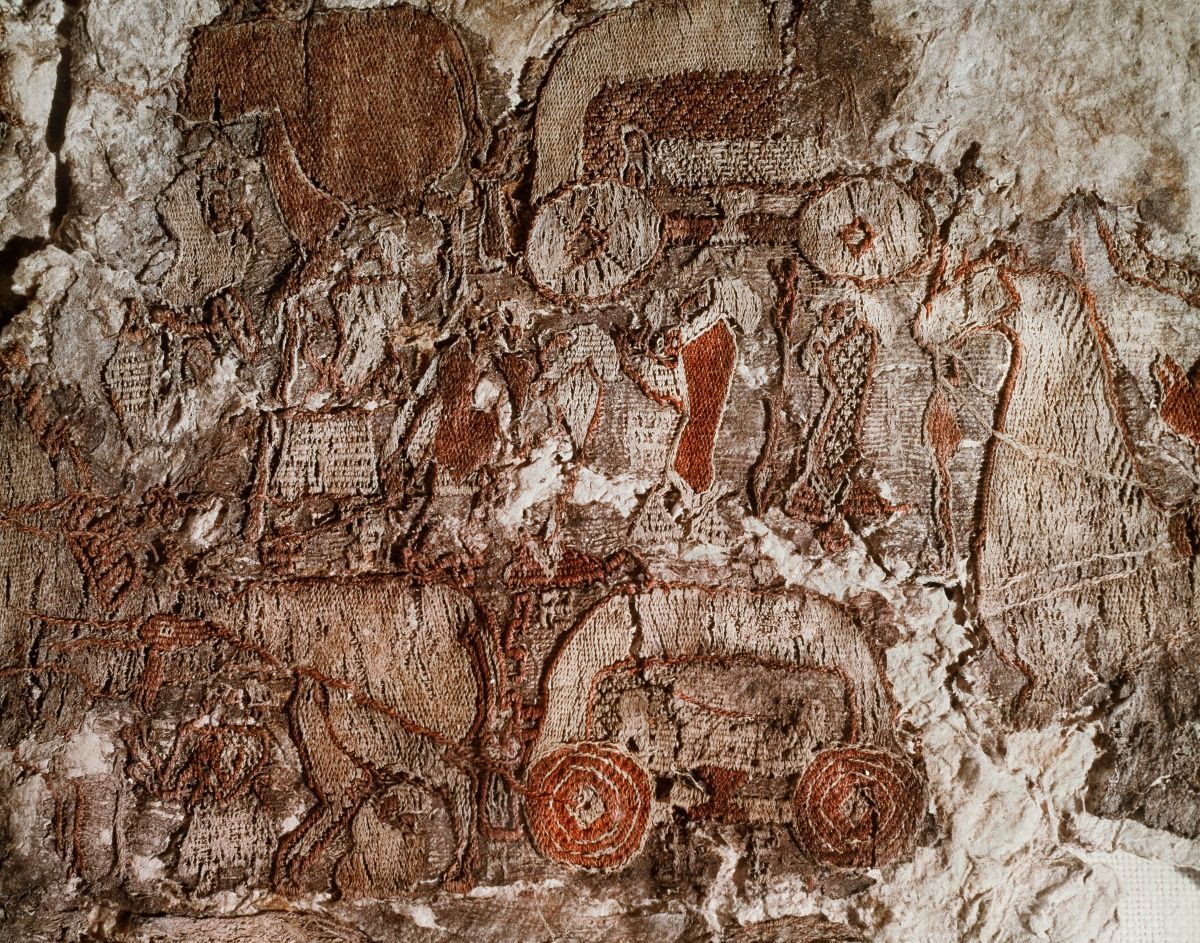
Originally, these fragments likely formed large narrative hangings used in ceremonial or ritual contexts. Today, though fragmentary, they remain exceptional evidence of Viking Age material culture (Vedeler, 2019).
"These textiles are not just artifacts — they are traces of human lives, creativity, and identity woven into material form."
— Marianne Vedeler, Silk for the Vikings (2014), p. 12
The Collection Includes
Tapestries
Narrative scenes with figures, animals, and processions
Embroidered Fabrics
Surface stitching with interlaced animal and human motifs
Tablet-Woven Bands
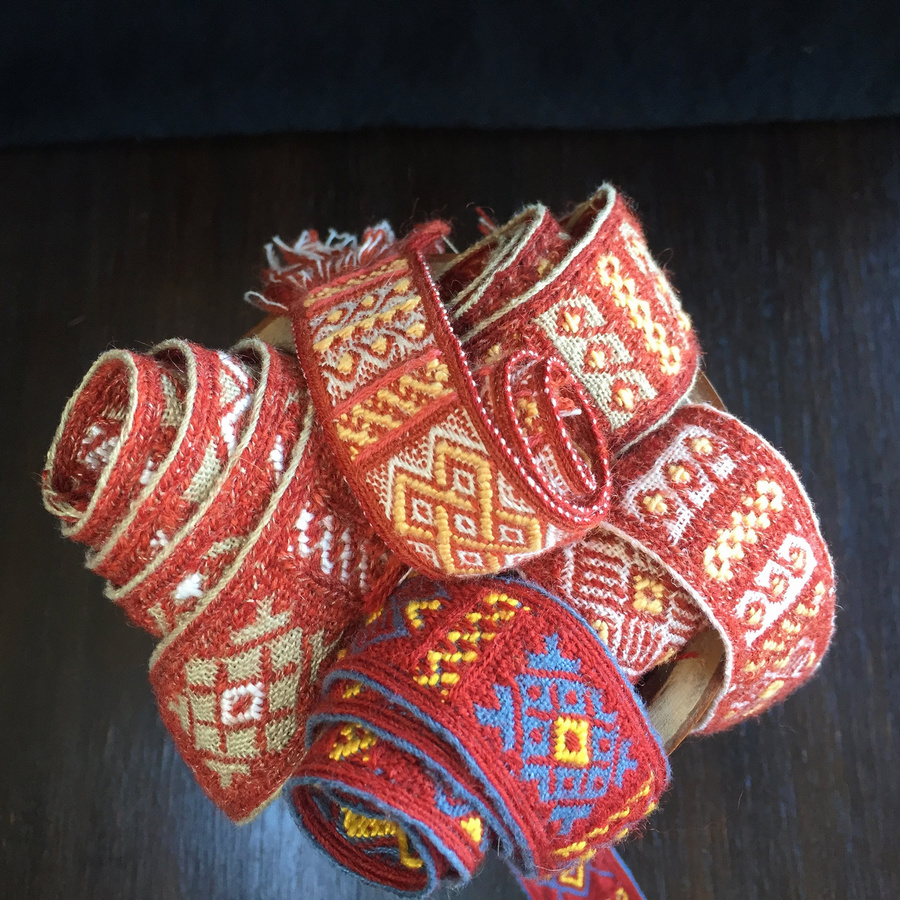
Borders and trims of extraordinary technical complexity
Materials
Woven from Three Worlds
Wool
Primary Base Fabric
Local Norwegian wool formed the structural foundation of most textiles. Its relative abundance made it the workhorse of Viking Age textile production.
Silk
Imported Luxury Material
Silk was not produced in Scandinavia. Its presence indicates direct connection to long-distance trade networks — arriving via Byzantium or Central Asia along Silk Road routes (Vedeler, 2014).
Linen
Structural Element
Linen provided smooth, fine ground fabric for certain garments. Flax was cultivated in northern Europe, making linen a local but refined choice for high-quality textiles.
Provenance & Custody
Where Are the
Textiles Now?
The Oseberg textiles are held in perpetuity as part of Norway's national cultural heritage at the Kulturhistorisk museum (Museum of Cultural History), University of Oslo — the same institution that oversaw their excavation in 1904 (Kulturhistorisk museum, n.d.).
The Oseberg ship itself was excavated from a burial mound at Oseberg farm, Vestfold, Norway, by Professor Gabriel Gustafson of the University of Christiania (now Oslo). The find was donated to the Norwegian state and has remained in public ownership ever since. The ship hull is displayed at the Viking Ship Museum (Vikingskipshuset) at Bygdøy, Oslo, while the textile fragments are stored and studied at the Kulturhistorisk museum.
Because organic materials are exceptionally fragile, most textile fragments are not on permanent open display — they are held in conservation-grade storage and made available to researchers. A selection of fragments and their documentation are accessible through the museum's collections database (Christensen and Nockert, 2006).
Custody & Curation Timeline
Gabriel Gustafson leads the University of Christiania excavation at Oseberg farm, Vestfold. The burial mound yields the ship, textiles, tools, and grave goods.
Textiles are removed, catalogued, and subjected to early conservation treatments. Some fragments are damaged in the process — a recognised limitation of the period's methods.
Artist Sofie Krafft produces detailed watercolour illustrations of the textile fragments, preserving colour and pattern information that would otherwise be lost as the originals faded (Krafft, 1956).
Osebergfunnet, Bind IV: Tekstilene is published — the definitive scholarly catalogue of all textile finds, edited by Christensen and Nockert.
The TexRec project at the Kulturhistorisk museum undertakes digital documentation and virtual reconstruction of the most fragile fragments.
Collection Type
National public collection
Norwegian state heritage — not private
Primary Location
Kulturhistorisk museum
University of Oslo, Bygdøy, Norway
Public Access
Partial — by application
Fragments in conservation storage; select items documented online
Materials & Technique
Materials, Making
& Technique
The textiles demonstrate advanced technical skill through multiple production methods, revealing both extraordinary craftsmanship and the global exchange of technical knowledge.
Warp-Weighted Loom
The primary structural weaving method, using a vertical loom with weighted warp threads. This ancient technique allowed complex patterns to be built up row by row.
Surface Embroidery
Decorative stitching applied to an already-woven ground cloth. Used to add figurative scenes, interlaced patterns, and fine decorative detail not achievable through weaving alone.
Tablet Weaving
A specialized technique using small cards or tablets to create narrow bands and borders of remarkable complexity. The 52-card unfinished weave is the standout example.
Remarkable Find
The Unfinished
52-Card Tablet Weave
Perhaps none is more evocative than the tablet-woven band left unfinished at the time of burial — still threaded on 52 tablet cards (Skogsaas, 2019).
Its unfinished state raises the remarkable possibility that one of the buried individuals was the maker — transforming these textiles into deeply personal objects (Skogsaas, 2022).
Weave Types & Global Influence
Technical Knowledge
Across Regions
Beyond materials, the weave structures themselves reveal cultural exchange. Diamond twill weaves appear across continental Europe and beyond, reflecting shared technical knowledge.
These techniques suggest Viking Age textile production was part of a broader network of knowledge exchange, craft transmission, and cultural interaction — showing that global influence operated not only through materials, but through skills themselves.
Diamond Twill — Regional Distribution
Local adaptation with Oseberg examples
Carolingian and Frankish textile traditions
Shared techniques and stylistic crossover
Advanced silk diamond twill exports westward
Origin zone for many complex weave traditions
A Unique Discovery
The Textile
Workshop
What sets the Oseberg burial apart from every other Viking Age grave is not just the textiles themselves — it is the extraordinary collection of textile production tools buried alongside them. No other Scandinavian burial comes close.
Other early medieval Scandinavian graves occasionally contain a single spindle whorl or a pair of shears — token objects suggesting a woman's domestic role. The Oseberg burial contained an entire workshop: not symbolic tokens, but the full, functional equipment of a master textile producer.
"This is not a burial that happens to contain textiles. This is the burial of someone whose identity was textile production."
— After Anne Stine Ingstad, The Oseberg Find, vol. IV: The Textile Finds (2006)
Tools Found in the Burial
Warp-Weighted Loom
A full-sized upright loom — the primary tool for producing large woven fabrics. Found with loom weights still in place.
Tablet Weaving Equipment
52 wooden tablets still threaded with an unfinished band — indicating active, in-progress work at the time of death.
Spindles & Spinning Equipment
Multiple spindle whorls of varying sizes for producing threads of different weights and fineness.
Wool Processing Tools
Full wool preparation kit including combs, carders, and shears — everything needed from raw fleece to finished yarn.
Needles & Embroidery Tools
Fine iron needles for embroidery and surface stitching — the tools behind the narrative tapestry imagery.
Comparison
No Other Burial
Comes Close
To understand how exceptional the Oseberg toolkit is, compare it with textile-related objects found in other major Viking Age burials across Scandinavia.
Oseberg, Norway (834 CE)
Complete workshopFull loom, 52-card tablet loom, spindle whorls, wool combs, carders, shears, needles, unfinished weave, raw materials
Gokstad, Norway (c. 900 CE)
Fragments onlySmall textile fragments, no production tools recovered
Birka Graves, Sweden
1–2 token objectsOccasional spindle whorl, single brooch with textile impressions
Mammen, Denmark (c. 970 CE)
No toolsEmbroidered textile fragments on clothing — no tools
"The Oseberg burial does not merely contain evidence of textile production — it preserves the entire productive chain, from raw wool processing to finished decorative weaving. This points not to a casual practitioner, but to someone who oversaw or led local textile production at the highest level."
— Adapted from Lise Bender Jørgensen, North European Textiles until AD 1000 (1992)
A Master Weaver's Burial
Evidence for a
Head of Production
Scale of Equipment
A full warp-weighted loom is a major piece of equipment — not portable, not symbolic. Its inclusion suggests the buried individual's identity was defined by large-scale weaving.
Work Interrupted
The 52-card tablet weave was still in progress. This isn't a finished offering — it's active craft, paused mid-production. The maker and the buried may be the same person.
Range of Skill
The toolkit covers every stage: spinning, weaving, tablet weaving, and embroidery. This breadth indicates either a master who practised all techniques or someone who directed a workshop of specialists.
Multiple Makers, One Leader?
Variations in stitching technique and design style across the textile collection suggest that multiple hands contributed to the work. This points to a collaborative workshop environment — possibly overseen by the buried individual as its leader or patron. In the Viking Age, textile production was both economically vital and socially prestigious; leading such a workshop would have conferred significant status.
An Economic Power Centre
Textiles were among the most valuable trade goods in the Viking Age economy. High-quality cloth, tablet-woven bands, and decorated hangings were exchanged across vast distances. A woman who controlled textile production of this quality and quantity would have wielded significant economic and political influence — making her burial in a richly furnished ship entirely consistent with her status.
Art & Influence
Art, Style &
Anglo-Saxon Influence
The Oseberg tapestries challenge the idea that early medieval Scandinavian art was purely local. Unlike typical art of the period — flat, 2D animal interlace — these textiles show narrative scenes with multiple figures, layered compositions, and attempts at spatial depth.
The embroidery motifs show strong similarities to Anglo-Saxon illuminated manuscripts, particularly works like the Lindisfarne Gospels — suggesting not just trade, but intellectual and artistic exchange.
Interlacing Animal Designs
Present in both Oseberg embroidery and Anglo-Saxon illumination
Stylized Human Figures
Similar proportions and postures in Lindisfarne-style art
Decorative Borders
Complex interlaced borders as framing devices in both traditions
What Makes These Tapestries Unusual
Typical Early Medieval Art
Flat, 2D animal interlace — no spatial depth or narrative
Oseberg Tapestries
Narrative scenes, layered compositions, spatial organization
Were designs copied from manuscripts? Did artisans travel? Were ideas transmitted through trade? The textiles suggest all of these — not just trade, but intellectual exchange.
Legacy & Significance
Meaning, Memory
& Power
The textiles had both practical and symbolic roles — as decoration, insulation, and display, but also as storytelling, ritual expression, and markers of social identity.
Practical Uses
- Decoration of interior spaces
- Insulation against cold
- Public display of wealth
Symbolic Uses
- Narrative storytelling
- Ritual expression
- Social identity and status
What the Oseberg Textiles Demonstrate
01
Global Connection
Viking Age society was not isolated — it was embedded in global exchange systems stretching from Norway to China.
02
Dynamic Artistic Traditions
Artistic traditions were hybrid and adaptive, drawing on influences from Anglo-Saxon, Byzantine, and Eastern sources.
03
Objects as Lives
These textiles carry personal, cultural, and symbolic meaning. They are traces of human lives — especially the unfinished weave.
Visual Evidence
Explore the
Textile Fragments
Photographs of surviving fragments, reconstructions, and archival images from the Oseberg textile collection. Click any panel to see full details and image credits.
Procession Tapestry Fragment with Figures

Procession Tapestry Reconstruction Detail

Sacrificial Hanging Fragment

The Sacrificial Hanging Reconstruction

Pictorial Weaving Fragment — Rolvsøy

Reconstructed Oseberg Silk Weaving

Silk Fragments — Clothing Trim

The Unfinished Tablet Weave

Tablet-Woven Band Reconstruction
Reconstructed Tablet-Woven Bands

Silk Embroidery — Enlarged Detail

Silk Embroidery — Animal Roundels
The Silk Embroideries
Embroidery from
the Oseberg Burial
The silk embroideries can be divided into two groups according to size and type. One group consists of small rectangular pieces cut into strips 3–4 cm wide; the other consists of larger pieces with ornamental patterns. All embroideries are done in multicoloured silk on a fabric which has now completely vanished — probably fine linen.
The embroidery techniques occurring are stem stitch, satin stitch, laid-work (couching), and split stitch. The colours have now faded to near-invisibility, stained brown by humus acids in the soil — making Sofie Krafft's early watercolour documentation invaluable.
Key fragments include round medallions with animal figures (12 B1), a griffin-and-trailing-vine motif (12 B2), spiral patterns (12 B3), and a remarkable cross with stylised birds between the arms (12 M3) — a motif common in Anglo-Saxon ornamentation.
Anglo-Saxon Influences
The patterning of the embroideries tallies with Western European, and especially Anglo-Saxon, art of the second half of the 8th century and early 9th. They are probably English work. They have parallels in the ornamentation of English manuscripts from the second half of the 8th century — illumination and embroidery appear to have flourished simultaneously in England at this time.
— Christensen & Nockert (eds.), Osebergfunnet, Bind IV (2006)
Use of the Embroideries
The rectangular fragments with turned-in edges, like the strips of silk, were probably used to decorate garments. The spiral-patterned fragments are probably parts of a single rectangular object at least 0.5 m long. Whether made locally or imported from the British Isles, these embroideries represent some of the finest surviving textile art from the Viking Age.
Wall Hangings — In Use
Tapestries as
Wall Hangings
The Oseberg tapestries were not kept in chests. They were hung on the walls of a longhouse — and the most prestigious position was directly behind the high-seat of the household's most powerful figure.
In Viking Age longhouses, the high-seat (öndvegi) was the socially and spiritually charged throne of the head of household. Flanked by carved pillars, it sat at the innermost end of the hall. The wall behind it was the room's visual focal point — the place of honour and, significantly, of display.
Longhouse Interior — Looking Toward the High-Seat
Schematic reconstruction
A Backdrop to Power
The tapestry hanging behind the high-seat created a visual backdrop for whoever sat there — connecting the living occupant to the mythological or ceremonial scene depicted. This was a deliberate, theatrical use of textile art.
The Social Theatre of the Hall
Everyone who entered the longhouse walked toward the high-seat end. The tapestry was the first thing they saw in the firelight — an immediate signal of household prestige, artistic refinement, and connections to myth or history.
Warmth, Insulation, and Beauty
On a practical level, heavy wool hangings insulated the walls against the Norwegian winter. But the choice to fill that insulating layer with extraordinarily skilled narrative art transforms a practical object into a profound cultural statement.
Trade Networks
Silk Roads &
Viking Age Trade
Since silk was not produced in Scandinavia, it arrived via long-distance trade routes — connecting Viking Age Norway to Byzantium, the Islamic world, and Central and East Asia.
Interactive Trade Route — c. 8th–9th Century
Hover over route points to learn more
Byzantium
Constantinople served as the primary silk distribution hub for the medieval Mediterranean and northern Europe. Varangian Guard members — Norse warriors in Byzantine service — traveled these routes regularly.
The Islamic World
Arab and Persian merchants controlled vast trade networks across Central Asia and the Middle East. Thousands of Islamic silver dirhams have been found in Scandinavian hoards.
Central & East Asia
Silk ultimately originated in China and passed through Central Asian oasis cities like Samarkand. The textile traditions of these regions influenced weave structures found in Oseberg.
Challenging the Stereotype
The presence of silk fundamentally challenges the image of early medieval Scandinavians as isolated raiders. Instead, the Oseberg evidence shows them as traders, cultural intermediaries, and active participants in a global exchange system.
Clothing & Identity
Clothing, Identity &
the Problem of Preservation
The procession scenes woven into the Oseberg tapestries give us a rare window into how the two women buried in the ship may have dressed: layered wool outer garments, linen underdresses, oval brooches at the shoulders, tablet-woven borders at the hem and cuffs, and head coverings that signal rank. Where the surviving textile fragments are fragmentary and dislocated, the tapestry imagery preserves the complete dressed silhouette — recording what the ground could not.

Reconstruction by Ellinor H. Hoff — click markers to explore dress elements
Head Covering
The tapestry figures show women with carefully arranged hair — possibly braided and wrapped, or covered with a draped fabric veil. Head coverings indicated marital status, rank, and religious or ceremonial role. The decorative border on the veil edge is executed in the same tablet-woven tradition as the bands found in the Oseberg burial. In the watercolour reconstruction we see the elaborately dressed woman's head wrapped in a red-dyed textile consistent with high-status female dress.
Interpretations based on Oseberg tapestry imagery and comparative textile evidence. Physical garments cannot be fully reconstructed due to burial disturbance.
Reconstruction by Ellinor H. Hoff — click markers to explore dress elements
Cloak Fastening
Norse women fastened their outer garments with a pair of oval brooches at the shoulders — one of the most distinctive hallmarks of Viking Age female dress. Between the brooches hung chains of beads in amber, glass, and sometimes silver. The Oseberg burial included metal objects consistent with high-status dress accessories, and tapestry figures clearly show this shoulder-brooch arrangement.
Interpretations based on Oseberg tapestry imagery and comparative textile evidence. Physical garments cannot be fully reconstructed due to burial disturbance.
Reconstruction by Ellinor H. Hoff — click markers to explore dress elements
Outer Cloak
The tapestry figures wear large mantles or cloaks — heavy outer garments draped from the shoulders and fastened centrally with a pin or brooch. Their borders are densely decorated with the exact type of tablet-woven bands found unfinished in the burial. The cloak communicated status at a glance; the richer the border, the higher the rank. The principal burial figure is shown wrapped in a deep red outer garment that extends from shoulder to ankle.
Interpretations based on Oseberg tapestry imagery and comparative textile evidence. Physical garments cannot be fully reconstructed due to burial disturbance.
Reconstruction by Ellinor H. Hoff — click markers to explore dress elements
Underdress / Tunic
Beneath the outer cloak, figures wear long ankle-length tunics or dresses in fine wool or linen. The Oseberg textiles include both materials, consistent with this layered approach. Decorative trim appeared at the neckline, cuffs, and hem — the Oseberg linen is among the finest known from Viking Age Scandinavia, suggesting garments of extraordinary quality.
Interpretations based on Oseberg tapestry imagery and comparative textile evidence. Physical garments cannot be fully reconstructed due to burial disturbance.
Reconstruction by Ellinor H. Hoff — click markers to explore dress elements
Woven Border Trim
The unfinished 52-card tablet weave is the most evocative of all the Oseberg textiles. Still threaded on its cards at the time of burial, it creates the extraordinary possibility that the maker was one of the buried women. Completed borders like these appeared at the hem, cuffs, and necklines of garments — requiring weeks of skilled labour for a single band. Decorative edging is visible along the lower hem of the principal figure's red outer garment.
Interpretations based on Oseberg tapestry imagery and comparative textile evidence. Physical garments cannot be fully reconstructed due to burial disturbance.
Appearance as Communication
The depiction of clothing and hairstyles in the tapestries highlights how appearance functioned as communication — expressing status, identity, and possibly spiritual roles. Even when physical evidence is incomplete, imagery becomes a crucial source of knowledge.
Dress Reconstructions
Viking Age Dress
in the Tapestries
Reconstructing Viking Age clothing is a persistent challenge: organic materials decay rapidly, and what survives from even the richest burials are typically small, fragmentary scraps. No fully intact Viking Age outfit has ever been recovered. This is where pictorial evidence becomes invaluable.
The Oseberg tapestry procession scenes are among the only surviving illustrations from early medieval Scandinavia that show how people actually dressed, moved, and arranged their hair — preserving details that no burial fragment could ever convey.
Viking Age Dress Variations — Oseberg Tapestry Procession

Male — Variation 1
Shirt & Tight Pants
The less elaborate type: a short belted shirt or tunic reaching to the knees or the middle of the thigh, worn with long tight-fitting pants. The tunic is a garment common to all four male variations.
- Short belted shirt or tunic to the knees or mid-thigh
- Long tight-fitting pants
- Belt at waist
- Foundation garment common to all four variations

Male — Variation 2
Shirt & Split Tunic
The same short tunic as Variation 1, but the legs are covered by a wide garment with a split. It is difficult to tell exactly what kind of garment this is — it may represent very wide short pants.
- Short tunic or shirt as base layer
- Legs covered by a wide garment with a split
- Split ending visible between the legs
- May represent very wide short pants

Male — Variation 3
Wide-Legged Breeches
Wide-legged breeches — voluminous trousers gathered at the knee — appear in the tapestry as a marker of status. Comparable finds from the Hedeby harbour deposits show this style was a prestige garment.
- Short tunic as base layer
- Wide-legged breeches — voluminous, gathered at the knee
- Associated with high-status male dress
- Paralleled by finds from Hedeby harbour

Male — Variation 4
Tight Pants & Mantle
Long tight pants with the rest of the body covered by a wide garment ending in two points — a wide, loose mantle. The mantle is the same type worn in the Roman and Migration periods.
- Long tight pants
- Wide loose mantle ending in two points
- Hem of a tunic visible between the mantle points
- Long sleeve and narrow neck lining sometimes visible

Female — Variation 1
Woman's Dress
Figures show a layered dress system: a long linen underdress beneath a heavy outer cloak fastened at the shoulders with oval brooches, bead chains between them, and tablet-woven decorative borders.
- Head covering indicating rank or marital status
- Long linen underdress (ankle-length)
- Heavy outer cloak fastened with oval brooches
- Bead chains in amber, glass, or silver between brooches
- Tablet-woven decorative borders at hem, cuffs, and neckline

Female — Variation 2
Women with Shields
Distinctive female figures in the Oseberg tapestry procession are shown carrying large round shields. Their dress follows the standard apron-dress silhouette, but the shields mark them as figures of ceremony or authority.
- Standard apron dress over linen underdress
- Oval brooches at shoulders
- Large round shield carried in one arm
- Possible head covering or bound hair
- Interpretation: ceremonial or mythological role
Special Reconstruction — Never Found in Any Burial

Illustration · Sophie Krafft
High-Status Female — Tapestry Imagery Only
The Belted Dress
One female figure in the Oseberg tapestry procession wears a distinctive outfit that has never been physically recovered from any Viking Age burial. A wide decorative belt at the natural waist cinches the outer dress, creating a fitted silhouette unlike the loose brooch-fastened dresses found in graves.
Source
Oseberg tapestry procession scene
Found in burial?
No — imagery only
Defining feature
Wide belt at natural waist
Silhouette
Fitted, defined — unusually modern
Outer dress
Dark wool, full-length
Inner layer
Silk panels at hem and sleeve

Possible imagining · Bente Skogsaas
The Ship Burial
The Oseberg Burial
& Its Makers
Context: The Ship Burial
The textiles were found within the Oseberg Ship — one of the most significant Viking Age archaeological discoveries. The ship contained two high-status women and a rich array of grave goods.
A Master Weaver's Grave
The evidence from the Oseberg burial, taken together, builds an overwhelming case: one of these women was the head of a major textile production operation — and possibly a spiritual leader whose authority was inseparable from her mastery of the loom.
Weaver, Leader, Weaver of Fate?
In a culture where weaving and fate were cosmologically linked — where the Norns wove destiny and the Valkyries wove the outcome of battle — a woman who commanded the full range of textile arts may have been understood as wielding a form of sacred, world-shaping power.
The Spiritual Dimension
Weaving Magic
& Sacred Power
In Norse cosmology, weaving and fate were inseparable. The Norns — the three figures who determined the destiny of every living being — were described as weavers, spinning and cutting the threads of life. This was not metaphor. In Viking Age thought, the act of weaving was understood as a form of world-shaping power.
"Wind, wind, wind the threads of fate — the Valkyries weave the web of war on a loom of spears, with a weft of human entrails."
— Darraðarljóð (The Song of the Spear), Njáls saga, ch. 157
Weaving & Fate in Norse Sources
The Norns (Eddas)
Three female figures who spin, measure, and cut the threads of every person's fate — using a loom at the root of Yggdrasil.
Darraðarljóð
Valkyries weave the outcome of battle on a loom of spears, with human heads as weights and intestines as thread.
Frigg — Goddess of the Household
Wife of Odin and associated with spinning, the distaff, and knowledge of all fates — though she never reveals them.
Völva — The Seeress
Norse prophetesses who practised seiðr (magic) — a practice described in terms of spinning, binding, and weaving enchantments.
The Weaver-Priestess
If the buried woman was both a master textile producer and a spiritual practitioner, she occupied a role where craft and ritual authority were fused — consistent with how Norse sources describe women who 'weave fate.'
Seiðr & Textile Magic
Seiðr — the Norse magical practice most associated with women — is described using textile vocabulary: spinning enchantments, binding fates, weaving spells. The tools of seiðr and the tools of weaving overlap in language and concept.
Power Made Material
The Oseberg textiles may themselves have been understood as objects of power — not merely decorative hangings, but woven expressions of authority, narrative control, and cosmological knowledge. To make them was to wield that power.
"The Oseberg burial may preserve the grave of a woman who was, in her community, both the master of the loom and the weaver of fate — a figure whose craft was understood as an expression of the deepest forces shaping the world."
— Interpretive synthesis; see Kathryn A. Ewing, The Valkyrie's Loom (2020)
Mysteries & Open Questions
What We Still
Don't Know
The Oseberg textiles raise as many questions as they answer. Here are the puzzles that scholars are still working to solve.
The 52-card tablet weave was still in progress at the time of burial. Was one of the buried women an active textile producer? Or was the loom simply part of the grave goods, not evidence of her craft?
Could be investigated by
aDNA profiling of the two buried individuals, combined with experimental reconstruction of the tablet weave (following Skogsaas, 2019), could test whether tool-wear patterns on the cards reflect a single practitioner's hand tension and characteristic error corrections.
The silk embroideries show clear parallels to English manuscript illumination from the 8th–9th centuries. Did they arrive as trade goods, or did a craftsperson trained in Anglo-Saxon techniques live in Norway?
Could be investigated by
Dye analysis and fibre isotope testing (LA-ICP-MS) could establish whether embroideries were produced in England or Scandinavia. Systematic motif comparison with dated 8th–9th-century manuscripts would narrow workshop origin.
Some scholars argue they depict the very funeral procession of the buried women — making the tapestry a visual record of their own burial ceremony. Others see mythological or ritual scenes.
Could be investigated by
Multispectral and X-ray fluorescence imaging of surviving fragments could recover detail obscured by soil staining. Comparative iconographic analysis with Gotlandic picture stones and Old Norse textual parallels could test specific narrative identifications.
One female figure wears a distinctive fitted dress with a belt at the natural waist — never found in any Viking Age burial. Was this a garment type that existed but hasn't survived?
Could be investigated by
Experimental textile archaeology — reconstructing the garment as depicted — could test whether its construction would survive typical burial conditions, distinguishing preservation bias from genuine rarity.
The textiles show variations in technique and style. Multiple hands are evident. Did one master weaver oversee a team of specialists, or was this a collective enterprise?
Could be investigated by
Microscopic thread-by-thread analysis comparing twist angle, yarn diameter, and dye lot variation could identify distinct production units. Error and correction pattern analysis has successfully identified individual hands in illuminated manuscripts.
The shield-bearing female figures are unlike any other female dress type in the tapestry. Are they Valkyries? Ritual role-players? Historical warrior-women?
Could be investigated by
Comparative iconographic survey of shield-bearing female figures across Viking Age Scandinavia, Anglo-Saxon England, and Frankish Europe; cross-referencing with Old Norse literary sources on valkyrjur and dísir.
Isotope and fibre analysis could pinpoint whether the silk originated in China, Byzantine workshops, or elsewhere. Tracing the exact route would reveal which trade networks the Oseberg woman accessed.
Could be investigated by
Strontium, carbon, and nitrogen isotope analysis of silk fibres can identify region of silkworm cultivation. Cross-referencing with Arabic dirham distribution maps from Scandinavian hoards could distinguish the Volga from the Mediterranean route.
No other Viking Age grave comes close in textile wealth and technical sophistication. Was this woman uniquely powerful? Did her workshop disappear after her death?
Could be investigated by
A systematic survey of all excavated female Viking Age burials across Scandinavia mapping textile tools against soil chemistry and burial type could test whether preservation conditions — not original wealth — explain the uniqueness.
"Even fragmented evidence — a weave structure, a tapestry image, an unfinished band — can provide deep insight into human lives, creativity, and the global connections of the Viking Age."
— Penelope Walton Rogers, Cloth and Clothing in Early Anglo-Saxon England (2007)
Personal Reflection
Reflections on
Studying These Objects
There is something peculiar about studying objects you can only see in photographs. The Oseberg textile fragments are held in conservation-grade storage in Oslo — accessible to researchers by appointment, handled by specialists in gloves. A significant portion of what we know about their original colour and composition comes from Sofie Krafft's watercolour illustrations, made in the decades after excavation, before the dyes faded further.
This layering of distance — object, illustration, photograph, screen — is not unique to this collection. But it has shaped how I think about the Oseberg textiles. The question of what to do with that partiality — how to reason carefully from fragments, how to resist the urge to fill silence with assumption — is, I think, the central challenge of studying material culture.
"The object that affects me most is the one most people would find least spectacular: the unfinished tablet weave, still threaded on its 52 cards. Not because it is the most visually arresting — the tapestry procession scenes are far more dramatic — but because of what it implies about a life interrupted."
— Veronica Furuakwa, Threads of Power: Digital Portfolio (2026)
Someone made those cards. Someone threaded them, planned a pattern, worked row by row. They stopped — not by choice, but because they died. The work became, by accident or intention, a burial offering. Its incompleteness is its meaning. No finished textile in the collection carries the same weight.
The Ordinary Invisible
The Oseberg collection is extraordinary precisely because it survived. But the textiles that once existed in thousands of ordinary Norse households — everyday cloth, workaday garments, worn-out hangings — have left almost no trace. We study the exception because the rule has vanished. That asymmetry should make us cautious about extrapolating too far.
Distance & Mediation
Every object we study is mediated: by excavation methods, by conservation decisions, by the analytical frameworks we bring. The Oseberg textiles have been interpreted through national romanticism, craft history, feminist archaeology, and world-systems theory — and each reading is partial. Knowing this doesn't make interpretation impossible; it makes intellectual honesty essential.
What Archaeology Does
Thinking archaeologically changes how you look at everyday objects. You begin to ask: who made this? How long did it take? What does owning it mean? What will survive in five hundred years? The habit of asking those questions — about early medieval Scandinavian cloth, about any object — is perhaps the most lasting thing the Oseberg collection has taught me.
How Understanding
Has Changed
The meaning of the Oseberg collection is not fixed — it has been actively reinterpreted across a century of scholarship, shaped by the intellectual frameworks of each generation.
When Gabriel Gustafson excavated Oseberg in 1904, the find was framed through the lens of Norwegian national romanticism: a queen's burial, a symbol of an ancient, heroic past. The textiles were treasures — but supporting evidence for a story about the ship. Their maker was background.
Oseberg interpreted as a royal queen's burial — a symbol of Norwegian antiquity. Textiles noted as beautiful but secondary to the ship. The maker invisible.
Krafft's illustrations become primary scholarly sources. Textile historians begin analysing weave structures, techniques, and materials in their own right (Bender Jørgensen, 1992).
Scholars like Anne Stine Ingstad reframe the burial: the tools are not domestic tokens but evidence of an economic and political power centre controlled by women.
Vedeler (2014, 2019) and Ewing (2020) situate Oseberg within global trade networks and Norse cosmology — a völva's grave, embedded in world-shaping craft.
"We do not know who these women were, or which of them — if either — was the master weaver. The bones cannot tell us that. The objects speak, but they cannot name their owner."
— Veronica Furuakwa, Threads of Power: Digital Portfolio (2026)
That silence is not a failure of evidence. It is the condition of archaeological knowledge. The task is not to fill that silence with certainty, but to ask better questions of it — and to let the objects remain strange enough to keep teaching us something.